
Quiz
(Some Facts & Figures, Questions, and Answers)

For our members’ night in June 2026, the topic of one of the talks was “Inside Distant Moons - How We Estimate Their Hidden Layers”. Here is some of the less technical information from the night that you can read before attempting the quiz below and refer back to. This is intended to be a learning experience - no need to stress about getting answers correct :-).
There are currently over 450 known moons around the eight planets, 13 around dwarf planets and dwarf planet candidates, and many more around asteroids and other smaller bodies. Most of these “moons” are irregular shapes - they are too small for gravity to pull them into a spherical shape. Of those around planets, less than 20 are spherical.
How do we know the inner structure of distant moons? Is there an iron core, and is it molten or solid? Is there an ocean below an icy surface? How deep is each layer? There are many techniques we can use to infer inner structure, including:
Calculate average density from size and mass. This is a basic, low-precision technique, but when combined with knowledge of the solar system from meteorites and formation history, can give a good estimate.
Observations of magnetic fields and aurora (clues about the core, and about subsurface salty oceans for icy moons).
Gravity field variations, moment of inertia (distribution of mass - a dense core or a more homogeneous structure).
Wobbles, tidal flexing and deformation give clues (different observations for a global subsurface ocean vs solid ice).
Crater sizes and shapes (subsurface ocean and ice thickness).
Seismic measurements, where available (so far only directly measured on our Moon and Mars).
Heat Flux / Surface Thermal Emission - Infrared mapping of surface heat output (such as Enceladus's tiger stripes, or Io's volcanic flux).
Computer models in conjunction with the above.
No single technique tells the full story - it is the convergence of independent lines of evidence that builds a reliable picture of what lies beneath. Some of these techniques can, of course, be used for rocky planets - for example, seismic measurements on Mars.
Differentiation
When a moon, rocky planet, or dwarf planet becomes hot enough to melt during formation, its materials separate by density. Heavy metals like iron and nickel sink toward the centre, while molten rock rises above them. Because iron and silicate rock don't mix, they form distinct layers, and any ices migrate toward the surface. This separation of materials into layers is called differentiation.
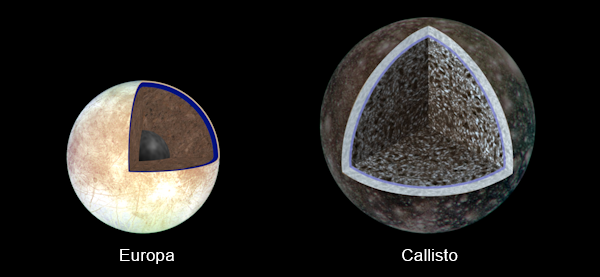
Not every moon ends up neatly layered inside. Callisto, Jupiter’s second-largest moon, probably formed too slowly to heat up enough for full differentiation. Gravity data are consistent with partial differentiation - a mixed rock–ice interior rather than a fully separated iron core.
Oceans
Two of the most promising places for life in the Solar System are Europa (a moon of Jupiter) and tiny Enceladus (a moon of Saturn). These moons both have global subsurface saltwater oceans.
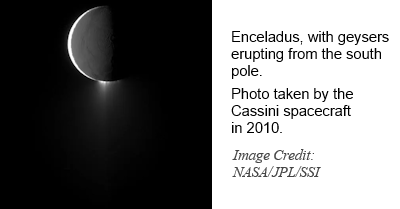
We know a lot about the ocean of Enceladus from the more than 100 geysers erupting from the “tiger stripe” region at its south pole. The water freezes into ice crystals - the heavier ones snowing back down to the surface, and the smaller ones forming Saturn’s E ring. The Cassini spacecraft flew through the plumes and the E ring, identifying molecules and minerals which confirmed the ocean is in contact with a rocky seafloor.
A technique that can be used very effectively at Jupiter, but not nearly as well at Saturn, involves magnetic fields. Salt water conducts electricity, so if a global saltwater ocean moves through a changing magnetic field, electric currents are set up in the water. In turn, these currents create (induce) their own magnetic field.
Induced magnetic fields at Jupiter’s moons Europa, Ganymede and Callisto were measured by NASA’s Galileo spacecraft in the 1990s. These could be produced by such subsurface oceans. Europa has a global ocean, Ganymede highly likely. However, in the case of Callisto, there is a possibility that the induced field is the result of ionised particles (electrically charged) in a thin layer around the moon, rather than by a saltwater ocean deep below the surface. Ganymede is particularly interesting - in addition to the induced magnetic field from its ocean, it is the only moon in the Solar System known to have its own intrinsic magnetic field, generated by a molten iron core.
The reason this works so well around Jupiter is that Jupiter’s magnetic field is tilted by about 10 degrees from its rotational axis. This means the strength and direction of the field at a moon’s position change over time as the planet spins and the moon orbits. Saturn, on the other hand, has a magnetic field that is much more closely aligned with its rotational axis, so for a moon orbiting near the equatorial plane, the magnetic field hardly changes with time, making this particular technique much harder to use there.
Saturn’s moon Mimas, sometimes referred to as the Death Star moon because of its large Herschel crater, looks like a frozen, heavily cratered ball of ice. The Herschel crater is about 130 km wide and 10 km deep, giving Mimas its distinctive appearance.
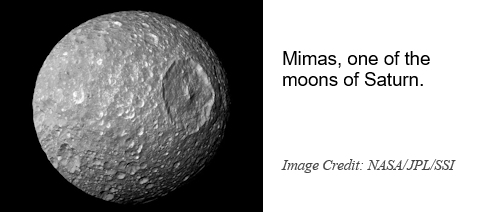
Mimas is surprising for a couple of reasons. First, its bulk (average) density is only about 1.15 grams per cubic centimetre, just above that of liquid water at 1 gram per cubic centimetre. This tells us it must be made mostly of ice rather than rock. Second, recent studies favour a young (probably between 5 and 25 million years old) subsurface ocean as the best explanation for Mimas’ wobble and orbital anomalies. Scientists used data from NASA’s Cassini spacecraft to show that Mimas wobbles in its rotation about twice as much as a solid ice moon should, and its orbit also shows tiny but measurable anomalies over time. The core is expected to be low-density and probably contains little iron, suggesting that Mimas either formed early in an ice-rich, iron-poor, region, or later from ring material with very little metal content.
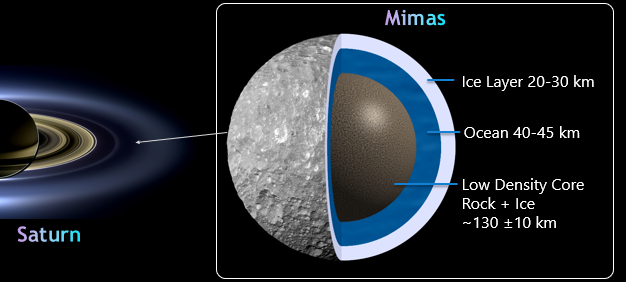
Possible internal structure of Mimas. Image credits: Saturn - NASA/JPL-Caltech/SSI; Surface of Mimas - NASA/JPL/SSI; Interior of Mimas - J Park
Fun Facts
1. There is evidence that Saturn’s moon Dione has an ocean, and hints that Pluto and Triton may have, or once had, oceans.
2. The densest moon in the Solar System is Io, one of Jupiter’s Galilean moons. Io’s density is 3.53 grams per cc, while our Moon comes in second at 3.34 grams per cc. Third place goes to Europa at 3.01 grams per cc.
3. The most volcanic body in the Solar System is Io. There are over 400 identified volcanoes on this moon!
4. Sixteen moons are currently known to orbit Neptune. The largest is Triton, which did not form with Neptune but was captured. Triton used to be a Kuiper Belt object, meaning it came from a region of the solar system called the Kuiper Belt. Pluto is the best-known Kuiper Belt object.
5. Neptune’s moons are named after minor sea deities, water nymphs, and other mythological beings associated with the sea, drawn mostly from Greek mythology, to match Neptune’s role as the Roman god of the sea. Triton is the only spherical moon of Neptune.
6. The moons of Uranus are named after characters from literature - primarily Shakespeare’s plays, with a few from the poems of Alexander Pope. The five major moons are Titania, Oberon, Umbriel, Ariel, and Miranda.
7. Three of Jupiter’s moons orbit in a 4:2:1 resonance. These are Io, Europa, and Ganymede. For every four orbits completed by Io, Europa completes two, and Ganymede one.
QUIZ QUESTIONS
You will need to record your answers separately (we don’t record your answers). You can find answers at the end.
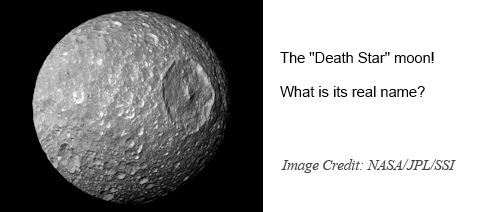
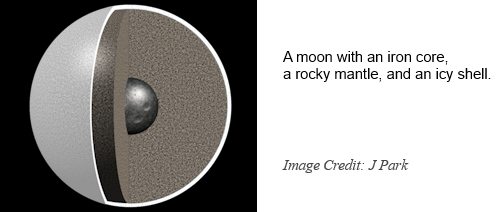
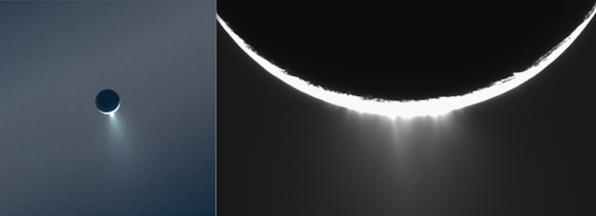
Image credit: NASA/JPL-Caltech/Space Science Institute (Cassini)
