
Quiz
(Questions, Answers, and some Facts & Figures)
If you came to “Surprises of the Solar System” at the HAS Public Night on 6 May 2026, you heard a lot of unusual and fascinating facts about our Solar System. Even though the talk covered a lot of ground, you may be surprised by how much you remember. But whether or not you were there, try the quiz below - it’s a fun way to test your knowledge of more unusual Solar System facts.
You will need to record your answers separately (we don’t record your answers). You can find answers at the end. If you want to keep your score, for anyone who may be new to these facts about the Solar System, a score of 1 or higher is good! Learning any new fact is a bonus.
More information from the talk is below the answers.
QUIZ QUESTIONS
ANSWERS

Surprises of the Solar System
Some of the facts and Figures from the Talk
Planets vs. Dwarf Planets
A planet and a dwarf planet both orbit the Sun and are massive enough for gravity to pull them into a roughly spherical shape - but one key difference sets them apart: a planet has gravitationally dominated and “cleared” its orbital neighbourhood of other debris, while a dwarf planet has not.
Here’s a summary of the official definition:
At its General Assembly in Prague on 24 August 2006, the International Astronomical Union (IAU) formally adopted Resolution B5, establishing three criteria for a planet in our Solar System:
It orbits the Sun
It has sufficient mass for self-gravity to achieve hydrostatic equilibrium (a near-spherical shape)
It has cleared the neighbourhood around its orbit
A dwarf planet meets only the first two criteria - it orbits the Sun and is roughly round - but shares its orbital zone with many other bodies and lacks the gravitational dominance to sweep them away.
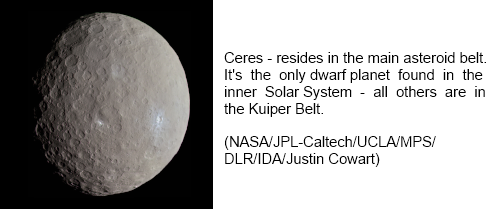
The classification was urgently needed because of the discovery of Eris in 2005, an object in a part of the Solar System known as the Kuiper Belt. The Kuiper Belt extends from about the orbit of Neptune to more than 55 times the Earth-Sun distance. If Pluto remained a planet, astronomers would have had to accept Eris - and potentially dozens more Kuiper Belt objects - as planets too. Rather than expand the planetary list indefinitely, the IAU created the dwarf planet category, reclassifying Pluto accordingly. The decision remains scientifically debated, particularly the vagueness of "clearing the neighbourhood" as a criterion.
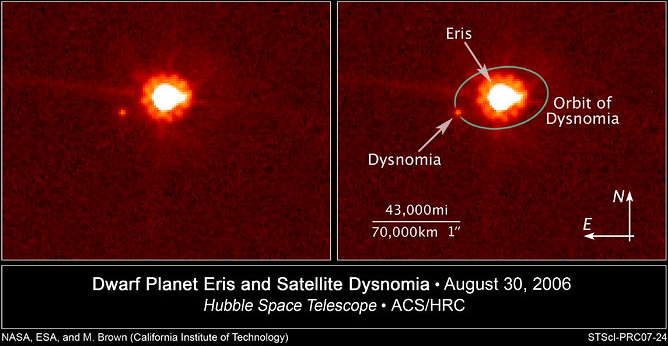
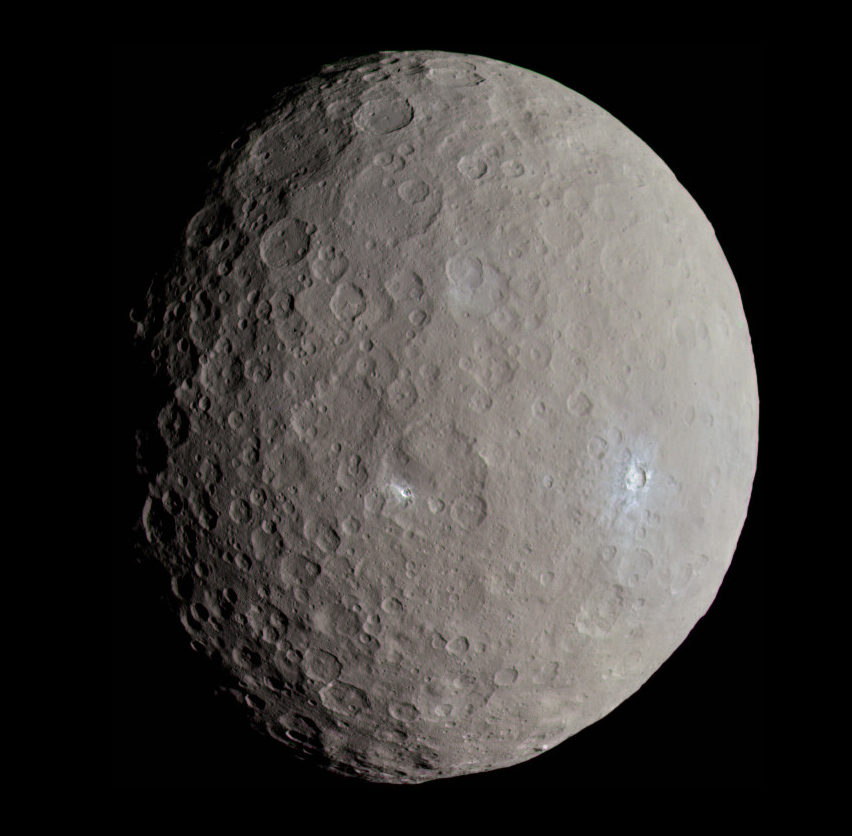
As of May 2026, there are five known dwarf planets (Ceres, Pluto, Haumea, Makemake, and Eris). There are six candidate dwarf planets (Orcus, Ixion, Quaoar, Salacia, Gongong, and Sedna). Of these six canditates, Orcus, Ixion, and Salacia are yet to be confirmed as spherical, which they must be to count as dwarf planets. Calculations of size, mass, and expected compositions of Quaoar, Gonggong, and Sedna, suggest that they are almost certainly spherical (physics!), so these are likely to be designated dwarf planets next time the IAU (International Astronomical Union) convene another session to classify additional ones.
Moons around the Planets and Dwarf Planets
(known as at May 2026):
Although there is a definition of a planet and a dwarf planet, there is no definition of a moon, except that it is natural object orbiting a planet, dwarf planet, asteroid, or Kuiper Belt object.
Planets
| Body | Moons | Notable Moons |
|---|---|---|
| Mercury | 0 | — |
| Venus | 0 | — |
| Earth | 1 | the Moon (In Latin, the Moon was called Luna) |
| Mars | 2 | Phobos, Deimos |
| Jupiter | 115 | 4 largest (Galilean): Io, Europa, Ganymede, Callisto |
| Saturn | 292 | Spherical moons (inner to outer): Mimas, Enceladus, Tethys, Dione, Rhea, Titan, Iapetus |
| Uranus | 29 | Spherical moons (inner to outer): Miranda, Ariel, Umbriel, Titania, Oberon |
| Neptune | 16 | Only spherical moon: Triton |
Confirmed Dwarf Planets
| Body | Moons | Known Moons |
|---|---|---|
| Ceres | 0 | — |
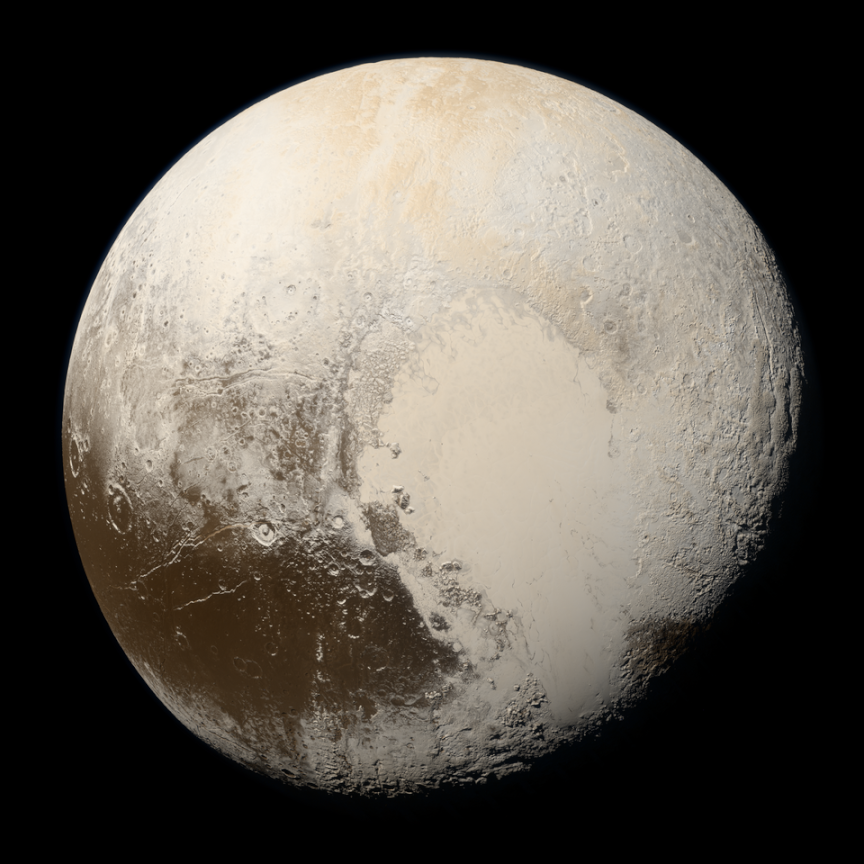
| Pluto | 5 | Charon, Styx, Nix, Kerberos, Hydra |
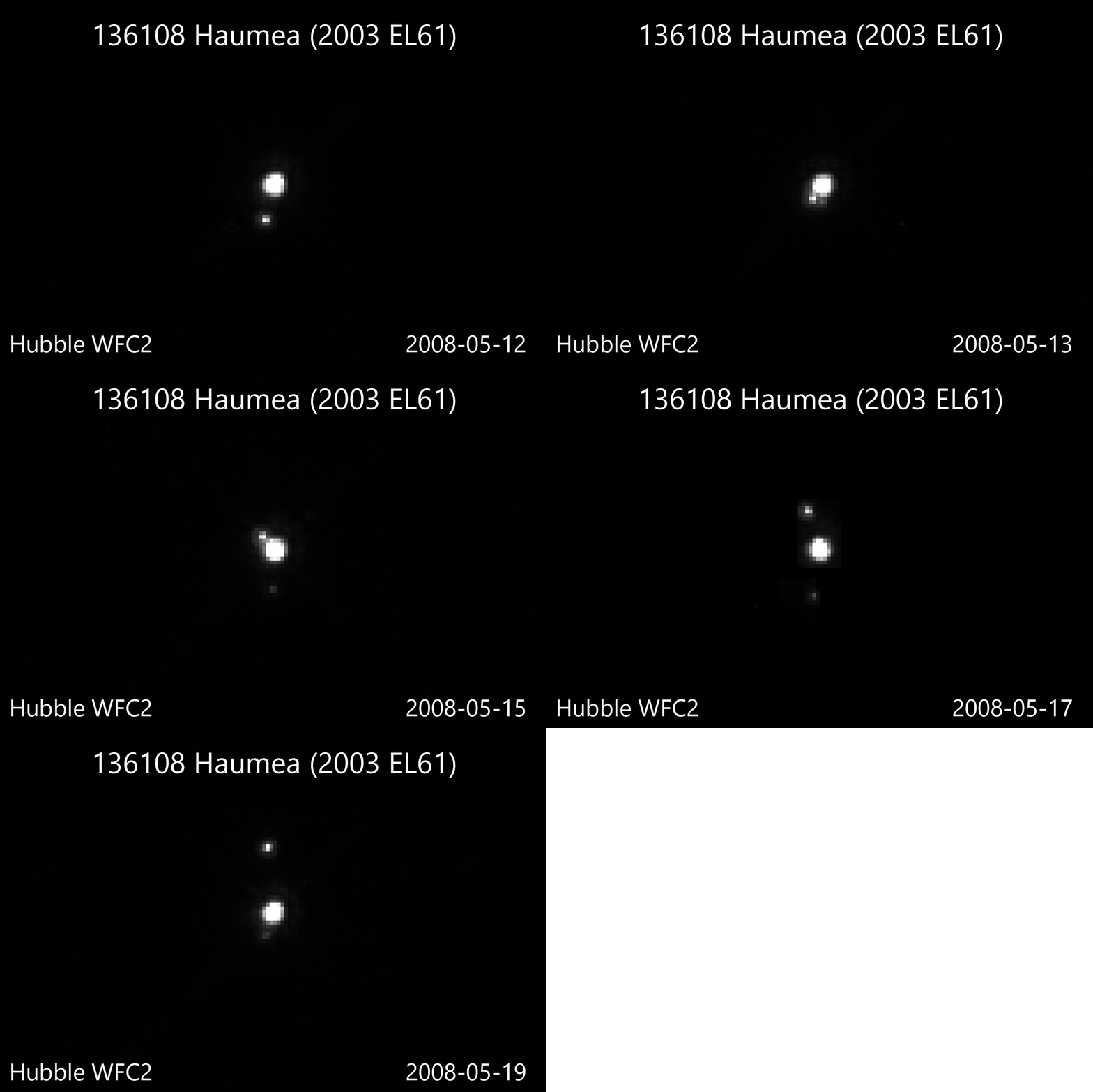
| Haumea | 2 | Hiʻiaka, Namaka |
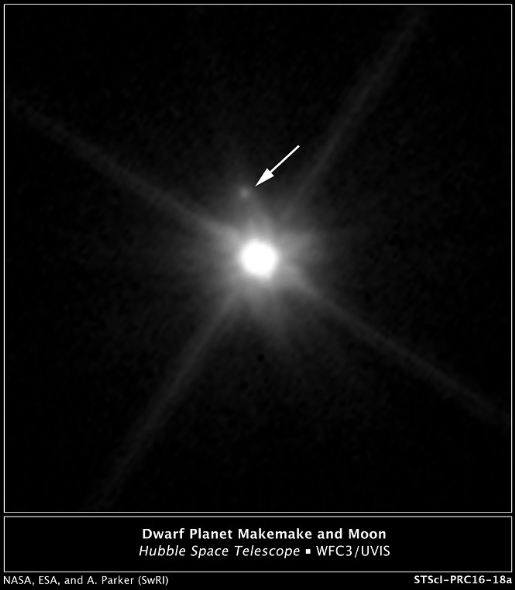
| Makemake | 1 | MK2 |
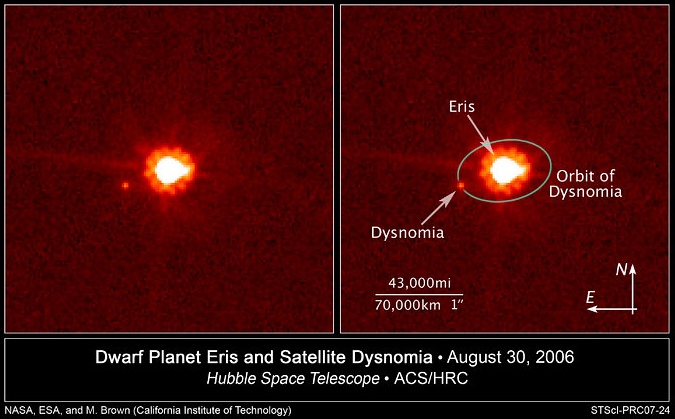
| Eris | 1 | Dysnomia |
Candidate Dwarf Planets
| Body | Moons | Known Moons |
|---|---|---|
| Orcus | 1 | Vanth |
| Ixion | 0 | None known |
| Quaoar | 1 | Weywot |
| Salacia | 1 | Actaea |
| Gonggong | 1 | Xiangliu |
| Sedna | 0 | None known |
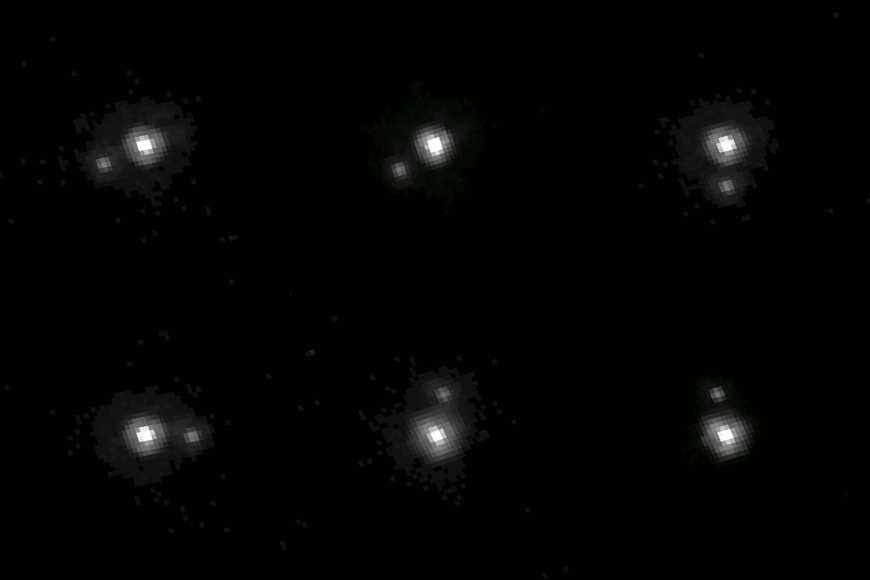
Images of Dwarf Planets
Click image for larger size.
These are not to scale relative to one another.
Animations are not true speed - the moons orbit much more slowly.
Left to right:
> Ceres (NASA/JPL-Caltech/UCLA/MPS/DLR/IDA/Justin Cowart)
> Pluto (NASA/Johns Hopkins University Applied Physics Laboratory/Southwest Research Institute/Alex Parker)
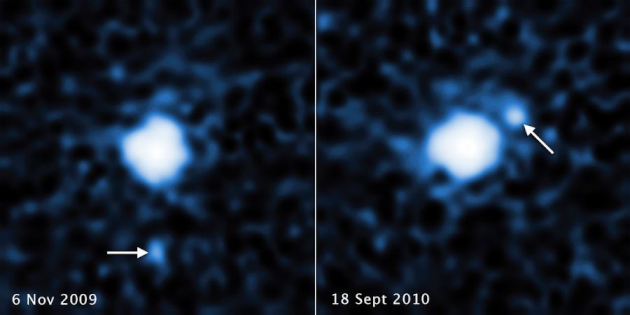
> Haumea with moons Hiʻiaka & Namaka (Hi’iaka is the brighter moon) (June 30, 2015 HST)
> Makemake with moon MK2 (Hubble/NASA/ESA/A Parker (SwRI))
> Eris with moon Dysnomia (NASA/ESA/M. Brown (California Institute of Technology))
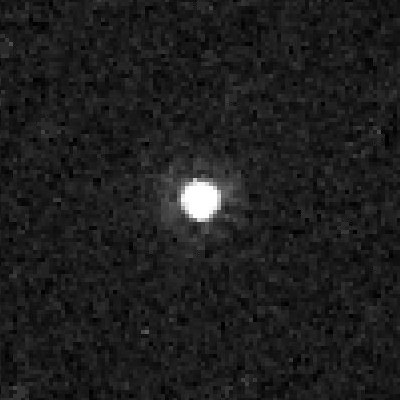
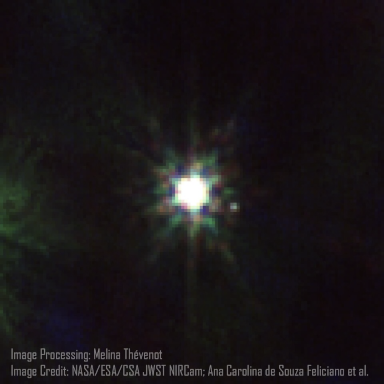
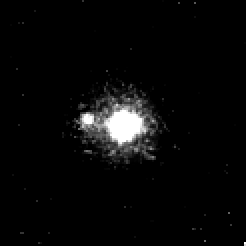
Images of Dwarf Planet Candidates
Not to scale relative to one another, animations not true speed.
Left to Right:
> Orcus with moon Vanth (HST/Michael E. Brown)
> Ixion (Hubble Space Telescope 2006 - see also Hubble Legacy Archive)
> Quaoar with moon Weywot (pronounce Kwah-war and Way-what) in Near Infrared.
(NASA/ESA/CSA/JWST NIRcam/Ana Carolina de Souza Feliciano et al)
> Salacia with moon Actaea (W Grundy/Keck Obs Archive/WMKO/NExScI/JPL-Caltech)
> Gongong with moon Xiangliu (NASA/ESA/C Kiss (Konkoly Observatory)/J Stansberry (STScI))
> Sedna (NASA/HST)
Plutinos, Twotinos, and More…
Pluto is a Kuiper Belt Object (KBO for short) - it lives out in a part of the Solar System known as the Kuiper Belt, containing probably millions of icy/rocky objects. This area extends from about the orbit of Neptune to more than 55 times the Earth-Sun distance.
For every three orbits Neptune completes around the Sun, Pluto completes two. We say it is in a 2:3 orbital resonance with Neptune. This can be written as 2:3 or 3:2 since when Neptune is involved we know Neptune’s orbits are represented by the larger number. About a quarter of all the KBOs also share that resonance with Neptune! So we call those objects in a 2:3 resonance with Neptune ... “Plutinos” after Pluto.
There are also other groups - Twotinos, Cubewanos, Plutoids, … - here is a summary of some of the groups.
Haumea - a particularly interesting example
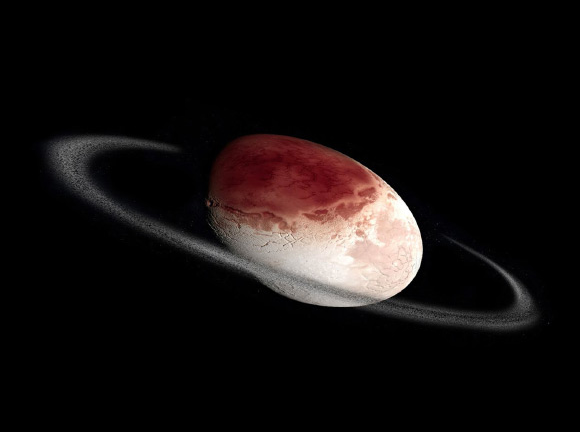
Artist’s impression of Haumea and its ring. The ring is not quite as wide as drawn here. (Image credit: Pablo Carlos Budassi, sourced from Sci.news)
Haumea experiences an intermittent 7:12 resonance with Neptune that breaks and reforms over millions of years. Haumea is a dwarf planet with one confirmed ring, and two moons. The ring is approximately 70 km wide, and located nearly 2,300 km from Haumea's centre. The particles in the ring orbit near a 1:3 spin-orbit resonance with Haumea's own rotation - that means Haumea spins 3 times for each orbit completed by a ring particle.
Haumea rotates extremely quickly - once every 3.9 hours. If you were standing in the right place on this dwarf planet, you would see the sun rise, then less than 2 hours later the sun would set, with less than 2 hours until the next sunrise. This rotation speed gives Haumea its rugby ball shape.
It's thought a giant impact billions of years ago stripped most of Haumea's surface ice away, set it spinning, and scattered debris that eventually became its two moons Hi'iaka and Namaka — and the Haumea family of KBOs.
Mercury Has a Tail!
Mercury has a faint sodium tail with an extraordinary length of about 24 million kilometres, stretching far away from the Sun. We can’t see it with our eyes because the glow is very weak and only shows up through special narrowband filters centred on sodium’s yellow-orange light. The tail is created when solar wind particles and micrometeorite impacts knock sodium atoms off Mercury’s surface, then sunlight and solar wind push those atoms away to form the tail. Other atoms (potassium, calcium, magnesium, and others) are also found in Mercury’s exosphere, but the sodium component is by far the easiest to image.
Our Moon has a Sodium Tail
Our Moon also has a delicate sodium tail, but it is much weaker and shorter than Mercury’s, up to about 800,000 kilometres long. It’s so faint that it can only be detected with very sensitive instruments and carefully tuned narrowband filters. Like Mercury’s tail, it is produced when micrometeorites and the solar wind release atoms from the lunar surface. These atoms are then pushed away from the Sun by radiation pressure (light) and the solar wind (particles), forming a thin, ghostly tail that occasionally sweeps past Earth.
What’s with those names?
This is a bit more technical, but if you are interested read on…
Asteroids, Kuiper Belt Objects (KBOs), and other objects orbiting the Sun other than planets and comets often have provisional names like 2024 YR4, and 2002 VE68. Comets and Moons are initially given coded names as well, but we’ll ignore those for now.
The format is the year of discovery, followed by a letter indicating the half-month of the discovery, and finally a letter or letter plus a number indicating the order of discovery during that half-month.
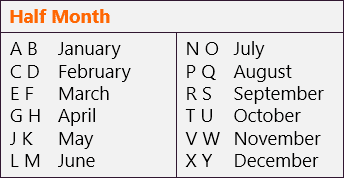
The half-month codes are as follows, with the first letter in the list below (A, C, E, ...) meaning between the 1st and 15th of the month, and the second letter (B, D, F, ...) meaning from the 16th to the end of the month. The letter "I" is excluded. So “A” is January 1st to 15, “B” is January 16th to 31st, and so on.
The order of discovery within the half-month uses a different formula: "A" represents the first discovery, "B" the second, and so on, up to "Z". "I" is excluded here again, so "Z" represents the 25th object. After that, the sequence restarts at A with a number suffix (A1 for the 26th, B1 for the 27th, etc.).
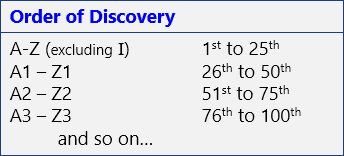
This system is a bit technical, but the following examples might clarify it. A computer program would certainly help!
2024 YR4:
Here, looking at "R4", “R” represents the 17th letter (skipping I), and the subscript 4 means the alphabet has been recycled 4 complete times (4 × 25 = 100 objects). Adding these: 100 + 17 = 117. So this is the 117th object discovered in the second half of December (that's the "Y") in the year 2024.
2002 VE68:
E = 5, and 68 x 25 = 1700, and 1700 + 5 = 1705. So this is the 1705th object discovered in the first half of November (that's the "V") in the year 2002. This object is nicknamed "Zoozve", which originated from a misreading of 2002VE!